Sunday, April 19, 2009

Sin Nombre


Last week I saw this film that was distributed in the United States by Focus Features, about two very different people whose paths cross on a train that carries illegal immigrants across Eastern Mexico, to the United States. Sayra is a girl from Honduras who is train-hopping with her estranged father and her uncle (who doesn't seem to be much older than her), hoping to get to New Jersey and join her father's family. Casper is a member of La Mara Salvatrucha in Chiapas (a violent, tatto-crazy Mexican gang), who betrays his gang after one of its members accidentally kills his upper-class girlfriend, and is now running from them on the trains. Sayra is nearly raped and killed by a member of the gang, but Casper rescues her by killing this gangmember (which causes the Mara to put a price on his gang), and because of that, despite warnings from the rest of the immigrants, Sayra sticks to Casper like glue, leaning on him, trusting him to get her across the border safely.
"Sin Nombre" is Spanish for "the unnamed". This film is about the millions of immigrants that try to reach the border to the U.S. all the way from the Central American countries, and the hardships they must reach to get there. On their way, some people help them by giving them food and direction, while other throw rocks at their trains and tell them to go home. Director Cary Joji Fukunaga (an American film director who has lived in France, Japan and Mexico) travelled on one of these trains himself to get the experience of being an illegal immigrant travelling to the United States, and therefore get the authnticity in the story. The film also brings La Mara Salvatrucha to the forefront. It's a real gang that has its origins in Central America (mostly Honduras, Guatemala and El Salvador), and has expanded through Mexico and even up to the States (the FBI held a raid against their activities in the U.S. back in 2005), and they've even expanded to places in Europe. The gang's activities include drug deals, arms deals, theft and murder. In the film, the tragic nature of this gang is viewed through the character of El Smiley, a 12-year-old boy whom Casper takes in as a rookie to initiate into La Mara, and through the film, you see how this sweet, innocent little boy loses his soul when he's initiated into the gang, and by the end of the film, his initial disdain for pulling a trigger and watching a life vanish right before his eyes disappears.
The film is very effective in creating suspense and keeping the characters constantly in danger and constantly alone. We care about Sayra and Casper, and their desperate situations, and we also care about Smiley, the kid who tragically falls in the wrong crowd (and we are constantly wishing he find his heart again). I think the film falters a bit with the relationship with Sayra and Casper, in the sense that we're never sure what the relationship is. They meet on the train, Casper saves her from getting raped, and we see how Sayra is constantly reaching out to him, practically trusting him to keep her safe, but I wasn't sure whether to view the relationship as a romance, or as a brother/sister, or as a simple protector relationship, and I was never sure how old Sayra and Casper were, so because of that, I was never sure what to think of the relationship. I think the film needed to be a little longer to explore this relationship further and understand it better.
Otherwise, I think this is one movie that should not be missed. It may be my bias of the language and the fact that the film is telling a Mexican story (and it's also produced by two of MExico's biggest stars, Diego Luna and Gael Garcia Bernal), but I do believe that the cinematography and the beautifully layered performances make this a worthwhile film. Also watch it to discover the landscapes of Mexico, even if they are some of the more dangerous places to explore.

Sunday, April 12, 2009

PIXAR Animation Studios


Nowadays, most animated films are computer-animated 3-D pictures. We have films such as Monsters vs. Aliens, the upcoming film Up, last year's Bolt and Kung Fu Panda, it's becoming rare that animated films are hand-drawn nowadays. But there was a time when a computer-animated film was a novelty. In 1995, the first full-length animated feature film was released in theaters to critical and commercial success, and won a special Academy Award for its technical achievement of computer animation. That film was Toy Story, about a cowboy doll named Woody (voiced by Tom Hanks) who is the leader of all the toys in Andy's room, but that position is threatened with the arrival of Buzz Lightyear (Tim Allen), the hottest space toy at the time who thinks he is the real Buzz Lightyear. The film went on to earn over $191 million in the U.S. and over $361 million worldwide. It exploded from there with films such as A Bug's Life, Monsters Inc., Finding Nemo, The Incredibles, Cars, Ratatouille and last year's WALL-E. However, before they made these films, PIXAR had a long history before that.
PIXAR was founded as one third of the Computer Graphics division at Lucasfilms back in 1979, and they worked on testing and creating visual effects that are now taken for granted in most films. They pioneered CG techniques that were used in films such as Star Trek II and Young Sherlock Holmes, before being bought by Steve Jobs back in 1986, shortly after Jobs left Apple Computers. George Lucas sold the division after the box-office flop that was his film "Howard the Duck", and the division was named Pixar, which was a fake Spanish word that meant "to make pictures" or "to make pixels" (and if it were really in Spanish, the accent would be on the "a". not the "i", but I do think it's kind of clever). Originally, Pixar was a computer hardware company that sold to government agencies and the medical community, but one of their clients was also the Disney company that wanted to use the technology to make a more automated and efficient process to their animation, rather than the Paint and Ink process they were using. In the meantime, one of their employees by the name of John Lasseter was creating short animation demonstrations to show off what the Pixar Image Computer (their primary product) could do. His most famous demonstration is Luxo Jr. (which is where the lamp logo came from, the lamp that crushed a ball).
Sales for the Pixar Image Computer were low, and with the company threatened to be put out of business, Lasster and his team made various commercials for products such as Listerine and LifeSavers. After several layoffs in 1991, The Walt Disney Company made a $26 million deal with Pixar to produce three animated films, the first of which was Toy Story. It wasn't until it was confirmed that Disney would distribute Toy Story that Steve Jobs decided against selling the company and giving it another shot (since it was costing him so much money to keep).
Disney and Pixar have had a tumultuous relationship over the last few years about control of the films. The original agreement was that Pixar would be in charge of making the films, and Disney would be in charge of distribution. Even though profit and production costs were split down the middle, Disney owned all the sequel and story rights, and they could make sequels without Pixar if they wanted to (even though they preferred to do it with Pixar). Disney and Pixar had a complete falling out in mid-2004, and it was announced that Pixar was actively seeking partners. The Incredibles was ready for release on its original date, but Cars was delayed until the summer of 2006 to allow time for these two companies to reach an agreement, and they created a distribution deal for Ratatouille to be released in the Disney channels, pending an agreement.
On January 24, 2006, Disney announced that it was buying Pixar for $7.4 billion, but a deal was made that it would exist a separate entity, and their next few films would be branded Disney-Pixar. They were also allowed to keep their studio in Emeryville, California, where they currently work.
What's amazing about PIXAR, in watching their movies, is their commitment to story and characters, but particularly the different voices that are present in them. The films work because they don't simply cater to the technology of the time, even though they try to advance the technology (which include a character's fur in films such as Ratatouille and Monsters Inc.) but they attempt to make these films timeless by granting us characters and stories that people can relate to. What people remember most about Toy Story are the characters of Woody and Buzz, and all the other toys in Andy's room. I remember seeing that in theaters for the first time, and becoming scared when I first saw Sid blow up a toy. I haven't missed a Pixar film since, and thus far, WALL-E is my favorite film because of the way it conveys a beautiful love story without much use of dialogue, but also because it's the one that feels the most vivid and real (at least in the scenes that happen on Earth), but I'm also a big fan of Ratatouille because of its infinitely smart and inventive screenplay, the message that speaks to the heart of what it is to be an artist, the creation of food on screen, and the unforgettable characters. My favorite scene in that film is the one where Anton Ego (an iconic performance by Peter O'Toole) tastes the Ratatouille, and has a flashback to how he first came to love food, reminding him why he does this in the first place (since he's introduced as a jaded food critic who didn't believe in the magic of the art anymore).
Pixar also has a great track record with the Academy Award for Best Animated Feature. The category first came out in 2001 (when Monsters Inc was nominated) and every Pixar film from then to now has been nominated in that category, and all but two have won (the only two that didn't win were Monsters Inc, which lost to Shrek, and Cars, which lost to Happy Feet). The Incredibles also won an OScar for Sound Effects Editing, the only time for an animated film so far. From its humble beginnings under the Star Wars universe, to being the gold standard for animated films and the company that pioneered computer-animated films, Pixar continues to challenge the audience with less commercial storylines that end up surprising the audience and becoming massive critical and commercial hits. The biggest box-office hit so far is Finding Nemo (which has the inimitable Ellen DeGeneres as a fish with short-term memory loss, a performance that never fails to make me laugh and cry, as well as the story of that film), and with Up being released in 3-D later this year, Pixar hopes to continue their track record and continue to release hit after hit.

Tuesday, April 7, 2009

Pinocchio (1940)


Just to be clear, I was not alive in 1940. I wasn't around when this film first came out, but for a long time when I was a little boy, this was my favorite film. When I heard it was coming out on two-disc Platinum DVD, I got really excited and didn't hesitate in purchasing it, even though I have a VHS copy back home. Flashes of the movie kept flying into my head from different scenes that I hadn't visited in years (that's how good my memory can be), and I couldn't wait to give it another look, and one thing that always surprises me about this movie is how it doesn't seem to age. There are many great movies from the 1930's and 1940's that have scenes and moments of dialogue that feel so ancient when we hear them nowadays. As much as I love Casablanca, it feels dated at times, and I took another look at Rebecca (also from 1940), and it really feels dated (creepy as it is), but Pinocchio still feels fresh and entertaining, and it contains scenes that we regrettably don't see in Disney movies anymore, because the industries feel they have to dumb everything down to cater to the children, and parents worry that children are fragile and can crack at any time, which in my opinion, it depends on the child, but I'll get to that as I get further into the review.
For those who may not know, Pinocchio is the film about Italian puppet-maker Geppetto who wishes that his latest puppet (a little boy he names Pinocchio) were a real boy. As he sleep, a Blue Fairy comes into his house and brings Pinocchio to life. She tells him if he proves himself brave, truthful and unselfish, he'll be made into a real boy. With the help of Jiminy Cricket (who becomes his self-appointed conscience), Pinocchio tries to be a good boy for his father, but he runs into temptations that get him into trouble, which include becoming a string-less puppet at a theater and joining a troupe of disobedient boys to Pleasure Island.
What I used to love about this film were the characters and the imagination that went into a every sequence. When I saw it this time, I marveled at the opening sequence in Geppetto's house, before Pinocchio comes to life, with the imagination that went into every music box in the house, every clock, every toy, everything has its own distinct personality, and they are all an extension of Geppetto. I especially loved Jiminy's reaction to every object and to Pinocchio particularly. One of my favorite moments is when Geppetto has just painted a mouth on Pinocchio, Jiminy says "very good, very very goo-", he looks at the sculpture next to him, which is a face with a low expression, looking very angry, and Jiminy says, "well, you can't please everybody." Then, when the Blue Fairy beings Pinocchio to life, that's one very magical moment, and we're introduced to Pinocchio's personality, a happy little boy willing to become flesh and blood. I saw in one of the special features that the character of Pinocchio was changed drastically, both physically and emotionally, from the stories by Carlo Collodi. Originally, Pinocchio was supposed to be an arrogant wooden puppet who is not very likable and goes on all these adventures to prove himself as a real boy, but he does it the wrong way. He also looked physically more like a dark brown wooden puppet. Disney decided to make him look more like a real boy, with only his wooden arms and legs and that stub he has for a nose to let us know he's made of wood (and his hands are covered with Mickey Mouse gloves), and his personality was changed to a well-meaning, naive little boy who easily gives in to temptation. This was made so children would have a protagonist they could easily root for and feel for. I don't know if it would have worked if they had left him the way he was in the books, but all I can say, this version of Pinocchio works.
Now I want to talk about my favorite character, Jiminy Cricket. Another view of this film made me love the character even more, not just because he's the sidekick, but I love his humor, his perseverance, his faith, but above all, his loyalty. No matter what happens, no matter how badly Pinocchio screws up, Jiminy always comes back. My favorite moment with Jiminy comes after he and Pinocchio have just found out that Geppetto was swallowed by a whale, and Pinocchio wants to go after him. Jiminy tries to talk him out of jumping into the water, but as soon as Pinocchio says goodbye to him, Jiminy's line is, "Goodbye? I may be live bait down there, but I'm going with you." I also love how seriously he takes his job as a conscience. He's committed to helping this wooden boy, and he's hard on himself, particularly in the scene where he and Pinocchio find themselves locked in Stromboli's cage. Before that, there's another scene that breaks my heart, and that's the scene where Stromboli locks Pinocchio in the cage, starts the carriage, and the cage is swinging back and forth, and Pinocchio is desperately whistling and calling for Jiminy. He known he's nowhere in sight, but he's desperate, and he needs Jiminy, and as soon as he realizes he may not be back, he sits down and cries. Meanwhile, Jiminy is outside, looking at the carriage, wanting to go away, but instead, he goes to say goodbye to Pinocchio, and that's when he discovers him in the cage. He's that committed to the job. He doesn't leave Pinocchio, even when he feels he's failed him.

No Disney film is complete without villains, and this film has a diverse cast of villains, and the odd thing about this film is that none of the villains gets their comeuppance (except maybe Monstro the Whale, but he's more a freak of nature). My favorite villain is Honest John (quite an ironic name for a character such as himself), a fox with a hat and a seductive British accent that acts as an agent of temptation for Pinocchio. He leads him into two of his most perilous adventures and trades him in for money. The man lies and cheats just to get in a pay day, and he doesn't care what happens to him after he's sold. Giddeon, his sidekick, a silent cat who walks next to him provides a perfect partner for Honest John to play off of for comedy. I love the scene where Honest John is diagnosing Pinocchio before taking him to Pleasure Island, and has Giddeon scrible in a notepad. That's just hilarious.
Now, I want to talk about Pleasure Island, because I was hit with something there that didn't happen when I was a kid. I thought that part was really scary, but the way I think of it, it's scary because it serves the story. Films back then had no problem exploring some darker places and scaring children out of doing things they shouldn't do, and in this case, that's smoking and drinking, and just plain acting like a jackass (nowadays, the word jackass warrants an automatic PG rating, and yet in this film, the word is uttered twice, and it's still G). One scene that I found particularly scary was the scene where Lampwick (Pinocchio's friend on Pleasure Island) turns into a donkey. We already saw the Coachman earlier (by the way, that character is also scary when he says earlier, "they won't be back..... as BOYS!!!!") selling donkeys and shipping them to different places, and we find out, from one donkey who can talk, that these donkeys are the boys who spent the entire day on Pleasure Island. In the following scene, we watch Pinocchio's face as Lampwick slowly grows ears, and then a tail, and then his face turns into a donkey's snout, and as cool Lampwick realizes what happened to him, he begs Pinocchio to help him. We see him kneeling next to him, we see his hands begging for help, and his hands turn into donkey legs right in front of him. It's a really scary scene, and then we see the same thing starting to happen to Pinocchio, and the tension grows. I wish more scenes like that could be written into more animated films nowadays, because I'm sure this scene scared a bunch of children out of drinking and smoking (at least for a while), and Dumbo also has a scene where he gets drunk and starts seeing elephants on parade that I heard gave people nightmares (and the Fantasia number from the Sorcerer's Apprentice gave my mom nightmares), but I honestly believe children are not as fragile as we think they are. They are more open-minded and can handle more than we give them credit for, so it bothers me that children's entertainment these days appeals to the lowest common denominator (with PIXAR as a glorious exception).

One thing I noticed with Pinocchio is that none of the villains get a punishment. They all continue with their villainous ways, but we don't really care, because we just want Pinocchio to get away from them. As soon as Pinocchio is out of the cage and away from Stromboli, he's still out there looking for a new act, and as soon as Pinocchio and Jiminy escape Pleasure Island, the coachman is still selling boys that turned into donkeys whose futures don't look too bright. It's disturbing when you think about it, but it works beautifully.
There's a couple of characters I forgot to talk about, and that's Geppetto's pets Figaro, the spoiled cat, and Cleo, the seductive female fish. These two are characters that depend more on their expressions and body movements for us to know who they are. We know Figaro always craves for attention, and Cleo loves to be kissed, even if it's just on her fishbowl, because it makes her feel pretty. This is something I hadn't noticed in the film until I saw her this last time, which made that scene at the end in which Figaro jumps into Cleo's bowl and kisses her all the more rewarding. Another character that was made quite frightening with no dialogue is Monstro, the whale that swallows Geppetto and Figaro and Cleo, and later Pinocchio as he searches for him. I remember the intense experience of watching Geppetto and Pinocchio trying to paddle away from the whale, and then the whale destroying their raft and Pinocchio having to pull Geppetto to shore, even when he tells him to swim for shore. This is the act that finally makes him worthy of being a real boy.
I remember hearing a rumor once that Jiminy Cricket was based on Cri-Cri, a cricket character who was the identity of Francisco Gabilondo Soler (the most important children's composer in Mexico). Apparently Walt Disney wanted to buy Cri-Cri for his films, but Gabilondo refused to do it. I don't know if that rumor was true, and from what I heard in a documentary on the DVD it may not have been (since they took a talking cricket character that Pinocchio squashes from the Collodi book and made him into Pinocchio's conscience), but since I grew up listening to Cri-Cri, hearing that made me even closer to Jiminy Cricket. It's probably just a rumor, but I love making that connection, because Pinocchio and Cri-Cri were huge parts of my childhood. It's fun to remember what used to be a part of our childhoods, and it's funny for me that my childhood memories were released to the world in the 1940's and 1950's (though I also grew up with Beauty and the Beast, Aladdin, The Lion King, and other cartoons from the 1990's). It was produced by Walt Disney, released in theaters by RKO Radio Pictures on February 7, 1940, and even though it didn't do very well in the box office on its first run (it only recouped 1.9 out of its 2.6 million budget). The film started catching on with re-releases, with the tradition that Disney films were re-released in theaters every 10 years (starting in 1944 for Snow White, and 1945 for Pinocchio) up until 1992 with a digital restoration. It remains a classic, and the Academy-Award winning song "When You Wish Upon a Star" has now become the theme of the new Disney logo.
So, is there any film you'd like to discuss that was this much a part of your childhood? Anything that hasn't aged for you? Or anything you may have re-visited lately?

Tuesday, March 10, 2009

Film Flashback: 2001

As you all know, I love watching movies. I love discovering classics and seeing what's new, how directors and actors evolve, and I also like to categorize these films by year. A lot of people say that movies nowadays suck, and that movies are no longer what they used to be, but I beg to differ. There have been some incredible movies out there, and some incredible years. I loved 2007, 2006 had some excellent offerings (including two movies I am obsessed with), 2004 also had some great stuff, but a year I want to talk about here is 2001. I was looking back at the films in the year 2001, some that I saw in the theaters when they came out, and some that I've discovered in the eight years since then (wow, has it really been eight years?). In 2001 I turned 13. I was still young enough to enjoy the kidfare, but I was already starting to broaden my horizons and seek out better movies. I still avoided R-rated movies back then (I didn't start watching R-rated movies regularly until 2002 for some reason), but looking back at the films of 2001, and my own personal list of favorite films, it's a year that brought so many interesting films, started some trends, and in other cases, simply provided some good old-fashioned entertainment. Before I dive into my Top Ten of that year, I'd like to talk about a few films that I loved back when I first saw them, but I've grown to see some of their flaws (though I still find merit in them).


A.I. Artificial Intelligence: I watched this film so many times at one point. I was caught up in the story, the visuals, the journey, even though it was a depressing movie, there was something about it that touched my heart when I first saw it and did for several viewing. However, now that I've seen a handful of Stanley Kubrick films, I wonder what he would've done with this story. What aspects of it would he have explored? How would he handle the flesh fair, the journey into Man-Hattan? Spielberg's take keeps some of Kubrick's spirit, but now that I think about it, it feels very sentimental and somewhat safe. There are still things I love about this movie. Teddy is still an adorable character, I love Jude Law's performance, the world created around it, the visuals, Dr. Know (I still have a soft spot for Robin Williams), and Haley Joel Osment was one hell of a child actor. I just wonder how much more could've been explored with it.


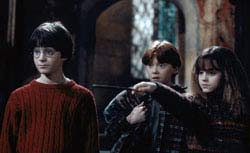
Harry Potter and the Philosopher's Stone: Funny story, when I was younger, I didn't want to miss out on this film, but my parents told me they wouldn't take me unless I read the book, so I picked it up three weeks before the film was released, and finished it about five days later. From then on I became a die hard fan of Harry Potter, devoured the first four books in less than two months, and read the last three as they were released. I saw the film so many times when it came out on DVD, and I really enjoyed the adventure. It's so faithful to the book, and that's one thing I enjoyed about it, but now that I think back on it, I think the fact that this film was so faithful to the book worked to its disadvantage. It's a fun fantasy adventure, but I feel that they missed a golden opportunity to dig a little deeper into the characters, into the world, into some other possibilities just because they wanted to incorporate the entire plot and please fans with it. Of course, from the third movie onward, the films followed the books a little less religiously and that allowed for some exploring of themes, and I love how those movies have matured. I still very much enjoy this one, and there are certain scenes and performances that are just a joy to watch (Alan Rickman is my favorite actor in this series, tough that may be because Snape is my favorite character). Also, this along with another film that I'll get to later gave a re-birth to fantasy franchises that have plagued the cinema in the last decade.


Gosford Park: This is the first Robert Altman film I ever saw, and I may need to give it another viewing, because I remember how much his ensemble style of characters talking over one another bothered me (and it's bothered me in some of his other films), but I remember being very impressed by the story and the performances in this film. There's a humor present in the British traditions, the system of masters and servants, and I love how we see it all from the eyes of one servant girl (played by Kelly Macdonald, first time I'd ever seen her and I was very impressed). The film is worth watching. It's sort of an Agatha Christie murder mystery with the Robert Altman style of characters (without an actual detective).


I am Sam: I need to talk about this film because I loved it for a really long time. Yes, it's sappy, it's not really realistic, and it's pretty irritating at times, but when I first saw it I found it very moving. It was the first performance I'd seen from Sean Penn (I'm better educated on him now, don't worry), and I was very impressed. I saw it at a time when I was obsessed with stories about people with mental and neurological disorders, such as Rain Man, Forrest Gump, Shine, and another film I'm going to mention later, and this one stayed with me for a while. I still love the opening with Sam organizing the cream and sugar packets at Starbucks (my sister is particularly fond of that opening), I discovered a lot of Beatles songs because of this film (I tracked down the original recordings by the Beatles of course), and it was the first performance I'd seen from Dakota Fanning, and was very impressed (before her cute little girl who is smarter than all the adults act got tired). I still found flaws with pacing back then, but despite its flaws, this is a film I can't help loving. Maybe it was just lucky I was still young enough to enjoy it back then.

Now, onto the Top Ten:


#10. The Majestic: I think this film is criminally underrated. It's a throwback to the classic Frank Capra films, about ordinary men who do extraordinary things. This one gets a little too schmaltzy at the end with the courtroom scene, but everything before it is beautiful. The colorful 1950's setting of a small town outside of Los Angeles that looks sort of like a movie set, and the people who look like they belong in an episode of I Love Lucy. It's a film that was made to inspire nostalgia, and even though I wasn't around during those times, I've seen enough films of those times to realize what they evoke. It was also a film that made me further respect Jim Carrey as an actor. I'd seen The Truman Show earlier, the first film that made me see him as a serious actor, and this performance is another one where he controls his schtick and energy to just give us a character. Frank Darabont is very good at telling stories. With The Shawshank Redemption and The Green Mile as proof, I think this one should've gotten more credit.


#9. In the Bedroom: What got me about this film was its quiet intensity and the way these characters hit breaking points. It's a simple story about a college boy who has an affair with an older married woman, and then has to deal with the woman's husband, and the consequences fall on the boy's parents. Those roles belong to Tom Wilkinson and Sissy Spacek. Tom Wilkinson carries his portion of the movie on his shoulder, You don't take your eye off him, even when he's about to do something unspeakable, and even though Sissy Spacek has some screaming scenes that can make you cringe, it's those moments when she doesn't say anything, or says very little in which she really lets you into her character. She's unforgiving, she's passionate, she's strict, but she's loyal and loving. It's a tough film to watch, but one that is really worth your time. I only discovered it three years ago myself, and it was worth it.


#8. Ocean's Eleven: This is a film I can watch so many times and I'll always enjoy it. What really carries this movie is the cast. It includes some of the biggest names in Hollywood, and some character actors here and there, but this is not a films where these men try to display their acting talents. They're all having fun. They all play off each other beautifully, they create moments of comic genius, and as the heist unfolds they keep you guessing. I remember when I first saw it, I enjoyed from the get-go. And then I bought the DVD, saw it quite a few times, started memorizing the dialogue, and realized how witty and suave the script is. I love the little moments between character where they tease each other, or ask about their wives, or what they heard about other people. Even though we're dealing with criminals and gamblers, the environment is friendly and cool. I love that about this film.


#7. A Beautiful Mind: This is a film that has lost some value on me with repeat viewings, but it was a very important film for me. It's the other film about a person with a mental disorder, but this is a true story about a man who despite that managed to win the Nobel Prize. It's a film that inspired me to want to do something great in the field I'm going in. When I first saw it back then I saw it as that, a film about a man whom I considered an inspiration. Now that I look at it withing filmmaking qualities, I see that it's a film that doesn't take a lot of chances with its subject. Ron Howard is a director who likes to play things close to the chest, never having the audience feel like they're in too much danger, and that's okay, it's his choice, though it's hard to wonder whether there are any missed opportunities. Still, I think the film works as a thriller, because it plants the question of what is real and what is in his mind. I love how the audience comes to care about what we learn is in his head, and at one point it kind of backfired, because I was asking John Nash not to ignore his friend, because even if he didn't exist, he existed for him and had a personality. The film works because it creates an emotional response with the audience and it keeps the audience guessing. I loved this film when I first saw it back in 2001, and even though it doesn't hold the same value now, I still think it's a worthy film.


#6. Monsters Inc: Yes, I know, me and Pixar. What can I say? They're amazing. I saw this film at a VIP theater, and what I loved most about this film were the characters and the originality of the world. I loved the concept of a monster world living in our closets and having to scare little children to get their electricity. The various characters and many ways they scare is fun to watch, and I find the story itself to be adorable. It's a buddy comedy, but it's also a father-daughter love story between a monster and a human child, and I loved what that created for the Sully character (voiced by John Goodman). This film has so much heart, but what wowed me the most when I first saw it was the action sequence on the doors in which they were looking for Boo's door throughout a parade of doors. I think it is, to this day, the most original sequence I've seen in an animated film.


#5. Shrek: I cannot believe it's been eight years since I first saw this. I still remember the movie-going experience with my parents quite vividly. My parents saw it with me and my sister, expecting a nice little Disney-type animated film, with some sweet original songs, a sweet story, lovable characters, you know, the way Disney made them (not that they didn't love those movies) but they were not prepared for what they got, and come to think of it, neither was I. I grew up on Disney, and I was really impressed with how this film turned everything I grew up with on its head, making an ogre into a hero, and breaking quite a few fairy tale rules. I wonder what Walt Disney would've thought of Shrek. Anyway, my dad was sold as soon as the Dragon falls in love with Donkey. I was sold from the minute Donkey opened his mouth and Eddie Murphy made me laugh for an hour-and-a-half, but I was also taken in by the originality of the story and the characters. Yes, it spawned some horrible Dreamworks films that focus on pop culture references rather than story, but that takes no merit away from this gem of a movie, which made a big splash when it first came out in 2001, had me and nearly everyone I knew talking about it, and I enjoy it all the more to this day. It's also one of the few films in which I really like the Spanish dubbing (I love how Mexican Donkey is).


#4. The Lord of the Rings: The Fellowship of the Ring: I actually hated this film when I first saw it in theater. I thought it was too long, too slow, and way too intense. I loved the opening, but I had felt it went downhill from there. After repeat viewing, it grew on me, and now that I've seen all three of the Lord of the Rings films together, I can say I truly love it. It's the beginning of the adventure and it took us three years to complete this adventure on the screen. That's another reason why I love 2001. With this, Shrek, Harry Potter and a few other films, fantasy came back to the movies after it had been somewhat absent for a while in favor of science fiction, and it brought us an adventure that most people didn't want t leave. Unlike Harry Potter, I haven't actually read these books (well, I started once, I couldn't get through it), but I was taken in by the rich detail in every character, every performance, every setting, the creation of this world, it's the reason why I watch movies and what I love most about going to the movies. Even though some of the over-emphasizing in exposition in certain scenes is overbearing, and some sequences go on for too long, it's a fantastic journey, and nowadays, every time I see this film, I have to put the other two right away, because it's an adventure I always want to see through to the end.


#3. Ghost World: This film never came to Mexico. I discovered it last year when I went on a renting spree, and I had heard about this film, so I decided to give it a go. I don't know what it is about this film that makes me care for two girls who do nothing but torture and play pranks. Maybe what I had learned about character archs and individual journeys, as well as the humor in so many of the scenes, made me root for Enid, a girl who was so lost in the world she inhabited that she spent all her time mocking the people in it, until she comes to care for one of those people, more than she ever had before. Character actor Steve Buscemi gives the best performance Í've ever seen out of him. It's a much more subdued performance than the ones we usually see from him and he nails it. I can't believe he didn't get an Oscar for this (or at least a nomination), and Thora Birch is amazing in the lead role. She manages to find layers to this little bitch that were just not present in the graphic novel it is based on (which I just read for an adaptation class). There's also a scene-stealing performance by Illeana Douglas as a pretentious High School art teacher who mentors Enid into the possibility of art school. Also, the film is very quotable, which is something I love in movies.


#2. Memento: I discovered this film about a year before I went into college, and I was very impressed by the structure and the complexities of the film. I loved the backward narrative and the alientaing sense of not knowing what the hell is going on, and the added frustration of following a character whom we can't trust because he doesn't know what the hell is going on, and if he does, he forgets it before he can make any sense out of it. After a few more viewings, I found myself noticing more details in the film, finding intriguing character traits and making sense out of the story of Sammy Jankis and of Leonard himself. By the time I saw this film, I had already seen Insomnia and Batman Begins, so I already knew what Christopher Nolan could do with suspense in a narrative such as this. He creates such an obscure world where characters try to take control of something much larger than themselves, and in this case, with a handicap. Leonard Shelby tattoos himself with information, takes photos, writes things down, he does whatever it takes to keep his world in order, but he doesn't remember where the information came from or what exactly it meant. He only has his system to trust, and we learn his system isn't very reliable. Guy Pearce takes us into the mind of this character, as far as he can take us, because we know more than he does about what happens next, and we have the rest of the characters filling in some blanks, with incredible performances by Joe Pantoliano and Carrie-Ann Moss. This would probably be my favorite film of 2001, if I didn't have a long history with the following film.


#1. Moulin Rouge!: This film is visual ecstasy. It's got so much style and so much flare that it's often hard not to be taken in by the music, the colors, the dancing, the characters, even in a paper-thin plot such as this one. I had mixed feelings about this film when I first saw it, loving the first half and hating the second half, but then I saw it many times, and the entire film grew on me. Baz Luhrman's manic style of directing and his love of this colorful world, it became something I couldn't get enough of. I remember this cruise I went to with my grandmother and cousin where they played this film so many times on the TV, in a different language every day (though never English) and since they kept the songs in the original language, we watched the films so many times in French, Spanish, Italian and German, and I never got tired of it. I don't think Nicole Kidman has ever looked more beautiful with that stunning red hair and her movements, it was hard not to fall in love with her. And Ewan McGregor's singing is truly amazing. His pipes, his charsma, his ability to play the straight man amongst this cast of lunatics is part of what kept me invested in his story. Outstanding work also from the hilarious John Leguizamo, the larger-than-life Jim Broadbent, and the mousy but no less threatening Duke, played by Richard Roxborough. This film may be spectacle, but it's a dazzling film, one that you can almost become addicted to. You laugh, you cry, you're dazzled, and you never forget it (at least I haven't).

Other films from this year that I saw in later years were The Royal Tennenbaums (which I thought was funny and moving with great performances, but really slow and at times pretentious), The Man Who Wasn't There (which I really need to see again, though I remember really liking it), Black Hawk Down (not that big a fan, but it's an achievement in action sequences), and I still need to finish Amelie and Mulholland Drive (two films I couldn't see all the way through for unusual circumstances). There are probably still many more films from the year I have yet to see, and I long to discover them. Any reccomendations from the rest of you? Any thoughts? Are there any other years you'd like me to evaluate in terms of the movies? Any years you'd like to talk about? I'll do more of these, and I may evaluate some films I've seen from decades before I was born. It's a great road to travel, discovering movies and remembering them.

Thursday, February 26, 2009

Oscar Night


Well, another Oscar season came and went, and this particular one was pretty lackluster overall. The excitement over the nominee list, the winners, there was too much predictability. It's the first sweep year we've had since The Lord of the Rings won 11 Oscars (it wasn't a clean sweep, but still a sweep), which are actually my least favorite years in terms of predicting Oscars, because it takes away from the excitement. I still thought Slumdog Millionaire was an amazing film, and I think it's a worthy addition to the list of Best Pictures. It's an uplifting, hope-filled film, a fairy tale of sorts that leaves you wanting to dance as soon as the final kiss is presented on the film, and then, what do you know, there's a dance number at the end, one that makes me want to get up and dance every time I hear it on my IPod (yes, I downloaded the song into my IPod, I'm a loser). I loved Danny Boyle's speech. He looks to be one hell of a guy, and I look forward to seeing more of his earlier work (already saw Millions and Sunshine), and the Best Picture win, in which everybody involved with the film went up to accept, including those adorable children (they made the film worth it, every second they were on screen), was such a rewarding Best Picture moment, probably more rewarding than having just the producers accept. This film belongs to India, and everybody who was involved. The only thing that upsets me about Slumdog's sweep were the wins in both music categories. I mean, the score was amazing, and I love the winning song, but I wish one of those Oscars had gone to Wall-E and Thomas Newman would finally have an Oscar to show for his career after 10 straight nominations without a win. Plus, I wish Wall-E, my favorite film of the year, had gotten a second Oscar, and maybe a third (Sound Effects Editing should have been a good one for it). I mean, I'm happy it won Best Animated Feature, but that was a given. It's an Academy-Award winner, but it was still a given. I wish it could win just one more Oscar, just for being arguably the best film Pixar has ever made (of course, "arguably" being the operative word).
Now, if I were to pick the winner for Best Picture out of my personal preferences, I would've gone with Milk, which is why I'm happy it won two Oscars, though both of these wins come with some disappointments. And I don't mean the speeches. Dustin Lance Black and Sean Penn gave two of the best speeches of the night, and I was happy to see them win, but this is what gives me pause. In the Best Actor category, I've kept going back-and-forth between Mickey Rourke and Sean Penn, not just who would win the Oscar, but who I like best. It's so hard to choose, they both gave amazing performances. I usually settle on Sean Penn for his energy, his smile and the fact that he gave us such a beautiful human being, but then images of Mickey Rourke's beautifully layered and heartbreaking performance flash through my mind, as well as seeing the man in the person. This guy is always just happy to be there, happy to be welcomed back into the club and given a second chance. Also, this is Sean Penn's second Oscar, and I don't think he deserved his first win. The more I think of Mystic River, the less I like both the movie and his performance. It's one of the times when I wish the Academy had waited to reward an actor, and that they'd given Best Actor to Bill Murray in Lost in Translation back in 2003 (or to make some fanboys and girls happy here, Johnny Depp in PotC, which I agree is a great performance). Anyway, I loved Sean Penn's speech, and I was glad to see him up there for what I believe is his best performance to date.
As for the Original Screenplay Oscar, it was great to see Dustin Lance Black give such a beautiful speech, but in a category with such amazing nominees, Milk doesn not feel like the best screenplay. It has great moments of writing, but it doesn't feel unique or to have a particular voice. Happy-Go-Lucky and In Bruges were both scripts with very distinctive voices and beautifully layered characters, and I know they would never vote for an animated film in this category, but I wish they had started with WALL-E. A film that could express such a beautiful romance with a very limited amount of dialogue is truly an accomplishment. Oh well, I'm glad Milk won two Oscars, showing love for a story that needs to be told and very much relevant to our times (though it can get a little annoying when Oscars get political).

Now, Kate Winslet's win, I'm going to see it as a career Oscar rather than a win for The Reader, because I do not think it's one of her best performances. She can do no wrong, and in this film she does no wrong, it just doesn't reach the depths that she's reached before, and reached this same year with Revolutionary Road. I wish she had won the Oscar for Eternal Sunshine of the Spotless Mind (did Hilary Swank really need a second Oscar back then), but still, it's good to finally be able to utter "Academy-Award Winner Kate Winslet. She deserves the title, and I hope she wears it proudly. I loved her speech too. My favorite moment of her speech was her dad whistling to let her know where he is. That was so adorable.
Last year, Javier Bardem was the first Spanish actor to win an Oscar. This year, the first Spanish actress to ever win an Oscar is the lovely and talented Penelope Cruz. I loved her in Vicky Cristina Barcelona. It's hard to give a bad performance under the direction of Woody Allen (unless you're Scarlett Johansson, whose been great in other films, but not under Woody Allen), and Penelope Cruz really sells this exotic spitfire of a woman whom we are told to fear way before she makes her grand entrance, and while she's on-screen, she makes the best out of it. I loved Penelope's speech, her nearly fainting on stage, her nod to previous directors who have made her successful (I especially loved the mentions of Fernando Trueba (director of Belle Epoque, one of her first films in which she's amazing) and Pedro Almodovar (she's been amazing in so many of his films)), and even though some people may say the Spanish part of the speech is obligatory for a Spanish-speaking winner, well so be it, because I never get tired of it (I love hearing that language).
As for Heath Ledger, well, we all saw it coming, but it was still rewarding. I always pictured Jake Gyllenhal accepting the award for some reason, but I am so glad it was his parents and sister who received the award. Three people who were not used to speaking to a crowd of celebrities, and were therefor very humbled by it. I love how genuine the moment felt.
A few obligatory Oscars went to The Curious Case of Benjamin Button (it was beautiful to look at, so I can't begrudge it that much), and one Costume Design Oscar went to The Duchess (when will the Academy start valuing costumes that are not period pieces), and The Dark Knight won a sound award. Not that many films won Oscars this year, but like I said, it's a sweep year.
As for the ceremony itself, there were things I really liked, and things I hated. What I hated the most were the acting presentations. I mean, everything that those actors to said to every one of those nominees, that congratulatory crap that was so over-the-top it would earn the Razzie for worst performance (well, I'm exaggerating, but it was still annoying). Why did they get rid of the acting clips. They're rewarding a performance, why not see a piece of that performance. Why not see those actors in character, doing what they're being nominated for, especially with films that only got an acting nomination, we saw no clips of them, like the films didn't exist. It may have been an idea to make the nominees feel like winners, but it was too long, and way too cheesy. I really hope this doesn't happen again (though apparently it will, since people responded to it). One thing I really liked was the theme of the ceremony, presenting the awards in the order that the crafts happen. Start with the screenplay, then build the sets, then shoot it, then add effects, sound and edit, and finally add the music, with the acting and other categories scattered throughout.
Hugh Jackman was an amazing host. Energetic, charismatic, great singing voice, great comic timing, not trying too hard to be funny. He was just being himself. And, the musical numbers were actually quite entertaining. I loved his opening musical number, particularly his dance with Anne Hathaway, and the clips of the year in comedy, animated, action, well, I'm not really a fan of montages during the Oscars, but apparently, they will continue to happen.
Anyway, 2008, was a pretty weak year for films, but there was still plenty to celebrate. I'm kind of glad it's over though, because I really want the Slumdog Millionaire backlash to start dying down (and I want to see how it ages as the years go) and I want to see what 2009 has to offer. Judging by the montage at the end of the show, it looks like we have some pretty good films coming up this year, some people will have great years.
Until next year.

Wednesday, February 18, 2009

Fox Searchlight Pictures


Some of my favorite movies that have been released since the beginning of the new century have been distributed by Fox Searchlight Pictures. Most of these films have been independent films, though some of them have been British films (including The Full Monty and last year's Slumdog Millionaire, both curiously written by Simon Beaufoy). Though it mainly distributes independent and British films, it is involved in production of some of their films. In the last three years, Fox Searchlight has made a strong showing at the Academy Awards with a film that was called "the little film that could" back in 2006 and 2007, and this Sunday, it is predicted (or some would say "it is written") that their nominee will be the winner.
Fox Searchlight is a film division of Twentieth Century Fox, which was established in 1994 to finanace these smaller films. Twentieth Century Fox is one of the six Worldwide major American Film Studios, which include Warner and Universal. Twentieth Century Fox was founded in 1935 with the merging of Fox Film Corporation (founded by William Fox in 1915) and Twentieth Century Pictures, which was founded in 1933 by Darryl F. Zanuck, Joseph Schenck, Raymond Griffith and William Goetz. It's currently owned by News Corporation, which is owned by Austrailian, right-wing magnate Rupert Murdoch. Fox has always been accused of being biased towards the right, in their news reports, in their programing. These right-wing tendencies doesn't affect Fox Searchlight's selection of films.

As we're approaching the Academy Awards this Sunday, I'd like to talk about Fox Searchlight's track record. they have had four films nominated in the last five years. The first one was the 2004 critical darling Sideway, directed by Alexander Payne, starring Paul Giamatti, Thomas Haden Church, Virginia Madsen and Sandra Oh. Sideways is based on a novel of the same name by Rex Pickett about a Middle School teacher/ aspiring writer named Miles Raymond (Giamatti), who takes his best friend Jack (Church) on a wine-tasting trip around California on the week before his wedding, where he discovers in a beautiful waitress named Maya (Madsen) a chance to redeem his life after his failed marriage and his failure to get a novel published. Sideways was a film that took the critics by storm, nearly cleaning out every major critics award that season, including LA and NY, and it wound up with five nominations including Best Picture, only winning an Oscar for Adapted Screenplay (by Alexander Payne and Jim Taylor), losing out to Clint Eastwood's Million Dollar Baby from Warner (I was personally more moved by Million Dollar Baby, but I found Sideways to be an impressive films upon multiple viewings. I don't find it that funny, but I find it very moving and I find the characters, while extremely flawed, very relatable). Sideways did sweep the Independent Spirit Awards with six awards including Best Feature, and awards for Giamatti, Church, Madsen and for Alexander Payne as a writer and Director.

Two years later the awards season recieved a small surprise in the little indie comedy that became a critical and audience darling, with its stunning cast, and it's colorful shade of yellow. This film is Little Miss Sunshine, from an original screenplay by Michael Arndt, directed by Jonathan Dayton and Valeria Faris, and starring Greg Kinnear, Toni Collette, Steve Carrell, Paul Dano, Abigail Breslin and Alan Arkin. I saw this film in the summer, way before it was getting any awards buzz, and remember loving it so much that it became my favorite movie that year, and to this day, I could see it 50 times, knowing every line, and not get tired of it. It's the story of a dysfunctional family that consists of a failed motivational speaker (Kinnear), his supportive wife (Collette), her suicidal brother (Carrell), his foul-mouthed, heroin-addicted father (Arkin), her mute-by-choice, Nietszche loving teenage son (Dano) and their wide-eyed, plucky daughter Olive (Breslin) who dreams of being a beauty queen. When she's invited to compete in the Little Miss Sunshine pageant in Redondo Beach, the family hops on their busted yellow VW bus and head to California. The film got a lot of critical praise, made over $100 million worlwide, and took a spot in the Oscar's Best Picture lineup (including three other nominations) with a campaign that included driving a yellow VW bus around LA and providing cupcakes. However, it lost Best Picture to Martin Scorsese's The Departed. It did win OScars for Best Original Screenplay and Best Supporting Actor (for Alan Arkin), and it won four awards at the Independent Spirit Awards, including Best Picture.

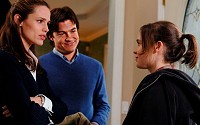
The following year, released what turned into its most commercially successful film to date, and also nabbed a spot in the Best Picture line-up. That film was Juno, from an original screenplay by Diablo Cody, directed by Jason Reitman, and starring Ellen Page, Michael Cera, Jennifer Garner, Jason Bateman, Olivia Thirlby, J.K. Simmons and Allison Janney. It's the story of Juno McGuff (Page) a 16-year-old girl who gets pregnant from a one-night stand with her best frend Paulie Bleaker (Cera) and finding herself unable to have an abortion, she decides to give the baby up for adoption. She finds the perfect couple in Mark and Vanessa Loring (Bateman and Garner), but things get complicated as she gets to know the couple more, and she is forced to face her true feelings for Paulie. The film became a cultural icon that brought upon a new way for people to talk, and it ended up maing over $143 million domestically and over $228 million worldwide. Diablo Cody and Ellen Page got the most praise for the screenplay and her performance. It wound up with four Oscar nominations including Best Picture, and won the OScar for Best Original Screenplay (Diablo Cody). It lost Best Picture to the Coen Brothers' No Country for Old Men, but it also won Best Feature at the Independent Spirit Awards, as well as an award for Ellen Page and one for Diablo Cody.

This year, the little film from Fox Searchlight that has taken the season by storm is Slumdog Millionaire, based on the novel Q & A by Vikas Swarup, directed by Danny Boyle, and starring Dev Patel, Freida Pinto, Anil Kapoor and Irfhan Khan. It's the story of Jamal Malik (Patel) a slumdog from Mumbai who is one question away from the grand prize in "Who Wants to be a Millionaire?". This leads to an investigation on how this slumdog cheated on the show, but Jamal reveals how he knew every answer on the show by linking it to a different even in his life. Up to now, the film has won almost every precursor award that has mattered, including the Golden Globe, the Critics Choice award, the NBR, and with 10 nominations including Best Picture, it seems to be poised to win the Oscar, which would make the first Fox Searchlight film to win this award. To think this films almost wasn't released in theaters. IT was abandoned by Warner Independent, and was about to go direct-to-video, until Fox Searchlight picked it up. Now it's become a phenomenon.
One thing you'll notice about these films is that Sideways, Little Miss Sunshine and Juno won OScars for their screenplays. That's one of the reasons I love films from Fox Searchlight, they are first and foremost, great stories. Stories that might be very funny, or very moving, or very affecting, but the studio looks for good stories to distribute. They're also the studio behind the distribution of In America, Thank You for Smoking, Waitress, Once, The Darjeeling Limited and The Wrestler just to name a few that I've loved. They also distributed Danny Boyle's Millions, Sunshine and 28 Days Later. It's a studio that is always on the lookout for something original and breathtaking, and actively campaigns to have it notices by the Academy and other voting bodies.

Tuesday, February 10, 2009

Coraline


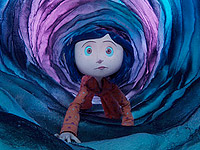
This last weekend I saw Coraline, the new stop-motion horror/fantasy film by Henry Selick, the director of The Nightmare Before Christmas and James and the Giant Peach. Coraline Jones is the daughter of two workaholic parents who just moved into a house out in the middle of some untended woods. Coraline is unhappy with her family. Her parents don't pay her any attention and she misses her friends from home. She wishes she could lead a different life. Her wish comes true when she finds a small door that leads to a world that looks similar to the world she lives in, only everything she ever dreamed about is true. Her parents are more lively and more attentive to her, and they give her everything she wishes. There's a giant garden outside, and her neighbors own a theater and a circus that put on shows that are a wonder to behold. The only thing she finds odd is that everybody on this world has buttons for eyes. She soon realizes that everything she ever imagined is just a trap to lead her away from what is important.
Coraline is the first feature film from Laika, a studio owned by Nike co-founder Phil Knight, and specializes in commercials, short films, music videos and now feature films. It used to be called Vinton Studios back in the 90's. It's comprised of 30 animators and their characters include M&M's, Frosted Mini-Wheats, and Hostess Penguin. Henry Selick previously worked on their short film Moongirl. Coraline was distributed by Focus Features, which is the art house film division of NBC Universal's Universal Pictures, which is owned by General Electrics. It has distributed films such as Brokeback Mountain, Lost in Translation, Milk, Gosford Park and Eternal Sunshine of the Spotless Mind, as well as several foreign films in the United States.
The film is based on a novel by Neil Gaiman, author of novels such as Stardust, The Sandman and The Graveyard Books. He paints an unpleasant world with characters that are not necessarily pleasant. Coraline is a brat, which is apparent from the moment she speaks. I found her initial scenes in the real world and with her parents to be extremely unpleasant, and I was ready to give up on this movie, but I knew that there was fantasy coming, so I decided to wait and see what that had to offer, and as soon as Coraline walks into this "Other World" where this film comes to life. There's so much imagination, so much playfulness and so much at stake in this world, that it simply sucks you into the adventure and you start caring about Coraline, because no matter what kind of brat she might be, no girl deserves to go through what she's forced to go through.
The film has a really hard time finding its focus when it stays grounded per se, which includes the writing in alot of the aftermath (not to spoil what actually happens and the trap that is set in the film), but all I have to say is that this film is most at home when it's relying on visual spectacle rather than story, and there are those moments where it can handle both quite well, but without the visual spectacle and the imagination is when this film feels a little weak. It's a very worthy film for me to open the year 2009 (I skipped everything that came before in order to catch up on some 2008 films), with some flaws, but when it marvels, it marvels.